
Coinbase marketing strategy, broken down from public data
More than 20 million people tried to open Coinbase in the minute after a QR code bounced across their TV screens. That 2022 Super Bowl ad is the stunt everyone remembers. It is also the least typical thing Coinbase has done. Most of its users came through far less glamorous doors: Google searches for coin prices, free crypto for learning, and a political campaign that turned customers into members.
I led EMEA user acquisition at Uphold, and Coinbase was the brand every crypto marketer measured themselves against. This is how its marketing actually works, built only from public records: its own results, press coverage, SEO data and what its marketing leaders have said on stage.
The numbers first
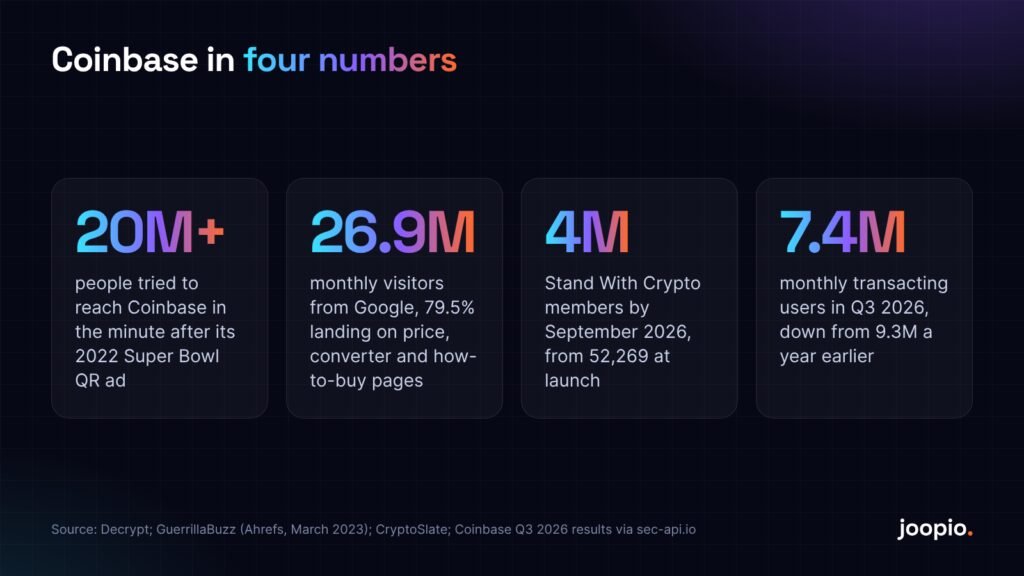
| Measure | Coinbase |
|---|---|
| Monthly transacting users, Q3 2026 | 7.4 million (9.3 million in Q3 2025) |
| Revenue, Q3 2026 | $1.22 billion, down 35% on a year earlier |
| Sales and marketing, Q3 2026 | $242.6 million, 20% of revenue |
| Of which USDC rewards paid to customers | $129.2 million |
| Super Bowl 2022 QR ad | 20 million+ people tried to reach Coinbase in one minute |
| Monthly visitors from Google (Ahrefs, March 2023) | About 26.9 million |
| Stand With Crypto members | 52,269 at launch in August 2023, 4 million by September 2026 |
The headline number most people miss: more than half of Coinbase’s Q3 2026 sales and marketing line was rewards paid straight back to customers.
Coinbase’s positioning: the safe front door to crypto
Every crypto exchange sells roughly the same thing: buy, sell and hold coins. Coinbase separated itself on two lines. It is the simple one, built for someone buying their first bitcoin, and it is the regulated one, a US-listed company that talks about compliance as a feature. Its 2026 Super Bowl ad ended on the line “Crypto. For everybody.” That is the whole positioning in three words.
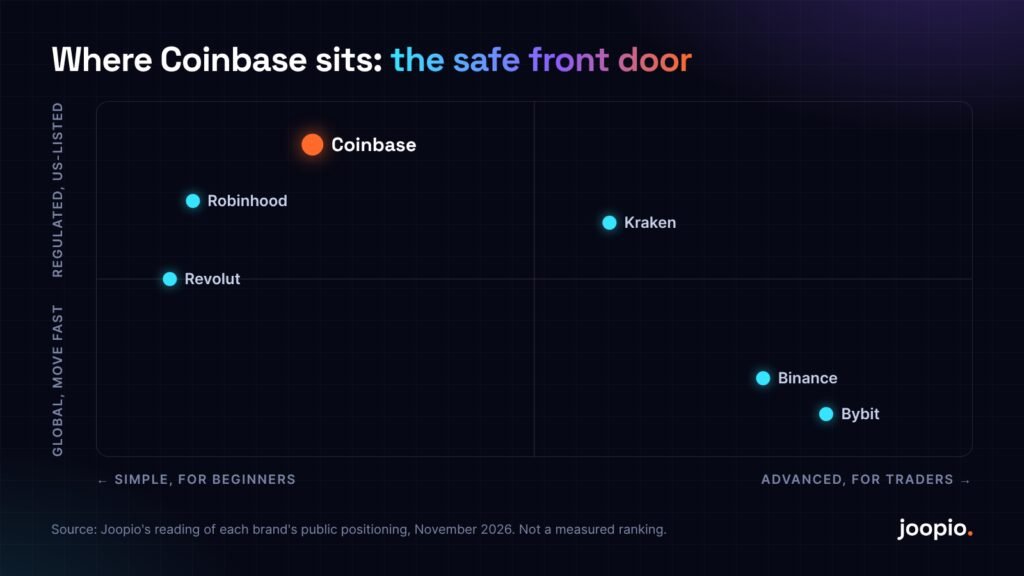
That position shapes everything else. A brand that promises safety cannot run the same hype ads as an offshore exchange, so Coinbase leans on education, big trusted media moments and politics instead. When it does provoke, it provokes the traditional financial system, not its customers. Its 2023 “Update the System” campaign went after overdraft fees and credit card minimums. Its 2025 UK musical “Everything Is Fine” went after the state of Britain.
The lesson: pick the one corner of the market you can own and make every channel prove it. “Safe and simple” is a position, not a tagline, and it rules out a lot of tempting tactics.
How Coinbase acquires users
1. It owns the searches that come before the sign-up
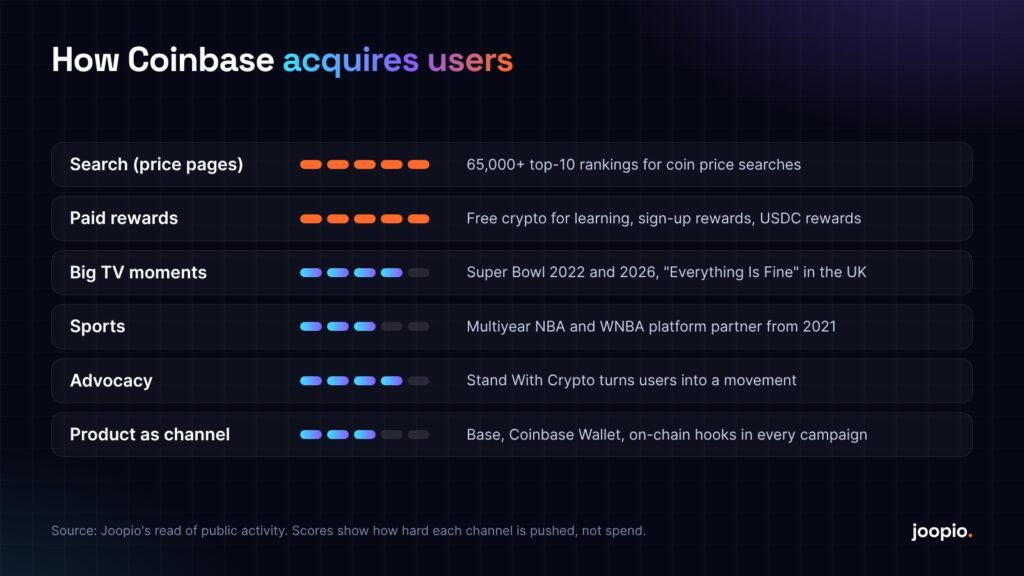
Nobody searches “best regulated crypto exchange” before buying their first coin. They search “bitcoin price”. Coinbase built a page for every coin’s price, a converter and a how-to-buy guide, and those pages rank. According to GuerrillaBuzz’s analysis of Ahrefs data from March 2023, Coinbase was getting about 26.9 million visitors a month from Google, and about 21.4 million of them, 79.5%, landed on price, converter and how-to-buy pages. It ranked in Google’s top ten for more than 65,000 coin price searches.
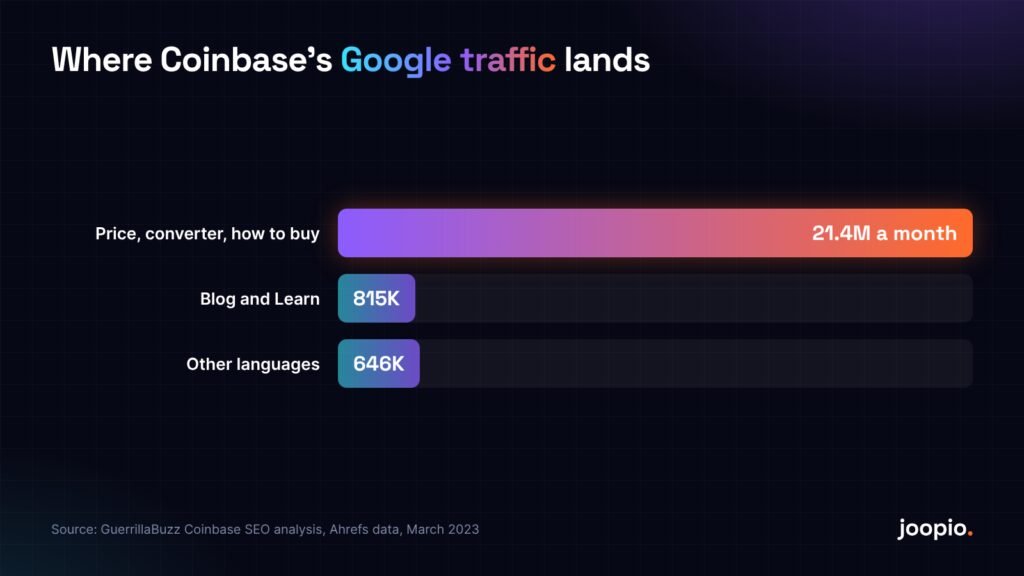
Each of those pages sits one click from “Buy”. It is the cheapest acquisition channel in the business, and it compounds every time a new coin trends.
The lesson: find the search your customer makes just before they need you, then build a page for every version of it. For a fintech app that might be exchange rates, fees or “how to send money to India”. Templates at scale beat a blog.
2. It pays people to try it
Crypto is confusing, and confusion kills sign-ups. Coinbase’s answer has been to pay for the first step. In 2019 it expanded Coinbase Earn to more than 100 countries, with a $100 million pool of crypto set aside for people new to digital assets. Users watched short lessons, took quizzes and were paid in the coin they had just learned about. The 2022 Super Bowl ad offered $15 of free bitcoin to new users. Today its rewards page still leads with “Get up to $400 in rewards”.
The rewards have grown into a line item of their own. In Q3 2026, Coinbase paid $129.2 million in USDC rewards to customers, which it counts inside sales and marketing. That is more than everything else in the line put together.
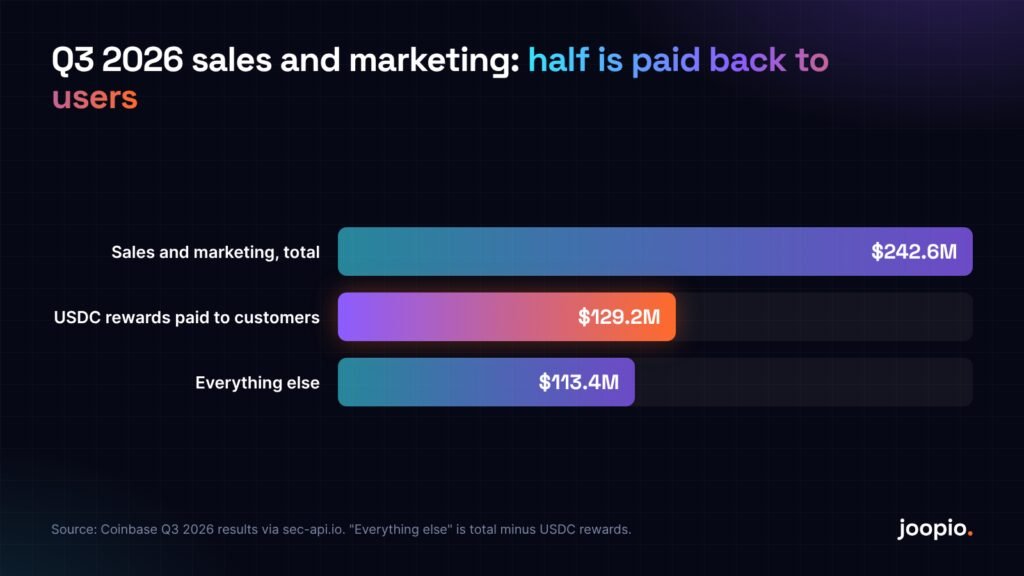
The lesson: if your product is hard to understand, pay for understanding, not just for the download. A reward tied to a lesson or a first action teaches and activates in one step.
3. Its TV ads are products, not films
Rival exchanges spent the 2022 Super Bowl on celebrities. Coinbase spent 60 seconds on a bouncing QR code with no voiceover. More than 20 million people tried to reach Coinbase within a minute, more than six times any load it had handled before, according to a post by then-CMO Kate Rouch. Marketing Brew reported more than 11.7 million website visits and a 24% sign-up rate. Demand was so high that many people could not get in at all.
Rouch later described the QR code as giving Coinbase a direct, opt-in relationship with millions of people who wanted to engage with the brand. Every campaign, she told Marketing Brew, would include an on-chain component that drives people into the product. The 2026 Super Bowl ad, “Everybody Coinbase”, was a karaoke lyric video set to the Backstreet Boys, again built so the audience does something rather than just watches.
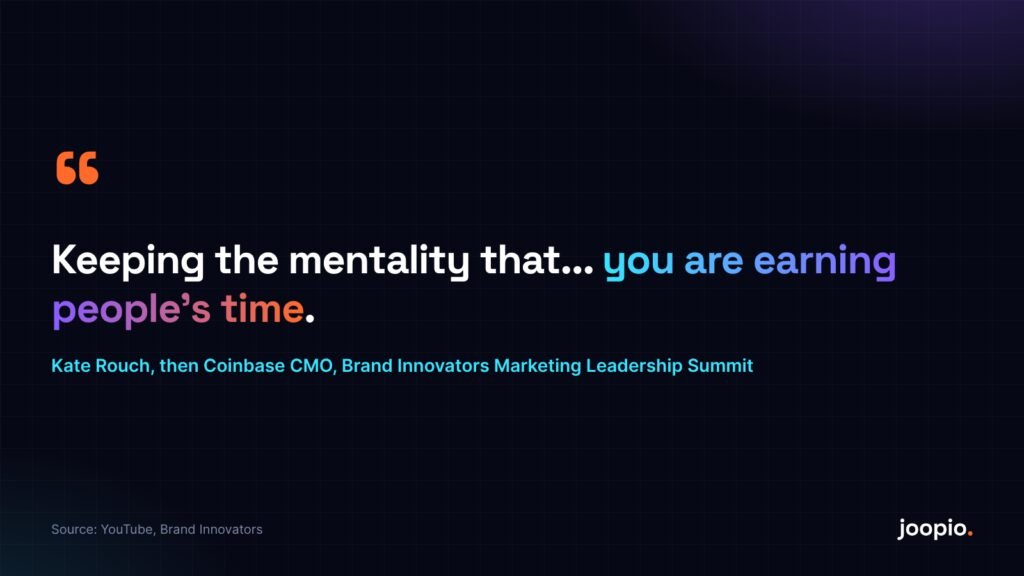
The lesson: an expensive media moment should end in an action, not a feeling. A QR code, a code word or a reward on the screen turns reach into sign-ups you can count. And load-test before you go live.
4. It cut spend in the crash but never went dark
According to iSpot figures reported by Marketing Brew, Coinbase’s TV spend fell from close to $38 million in 2022 to close to $10 million in 2023, a figure Coinbase said was “about correct”. It cut hard. But it kept showing up, with cheaper and stranger work: an NFT penny campaign that saw 172,000 minted, and an ad on Liquid Death cans. Rouch’s line was “You saw us in the bull, and you’re seeing us in the bear.”
The sports deal stayed in place too. In October 2021 Coinbase became the exclusive cryptocurrency platform partner of the NBA, WNBA, NBA G League, NBA 2K League and USA Basketball in a multiyear deal, the first crypto platform partnership for each league.
The lesson: in a downturn, cut the cost of being seen, not the fact of being seen. Cheap stunts and owned channels keep the brand present while rivals disappear, and the attention is cheaper.
5. It turned customers into a political movement
This is the most unusual move on the list. In August 2023 Coinbase launched Stand With Crypto, an advocacy group for people who want clearer crypto rules. The page showed 52,269 advocates on launch day. By June 2024 it had passed one million. In October 2024 Coinbase committed to helping it reach four million before the 2026 midterms, and in September 2026 Brian Armstrong said it had done so.
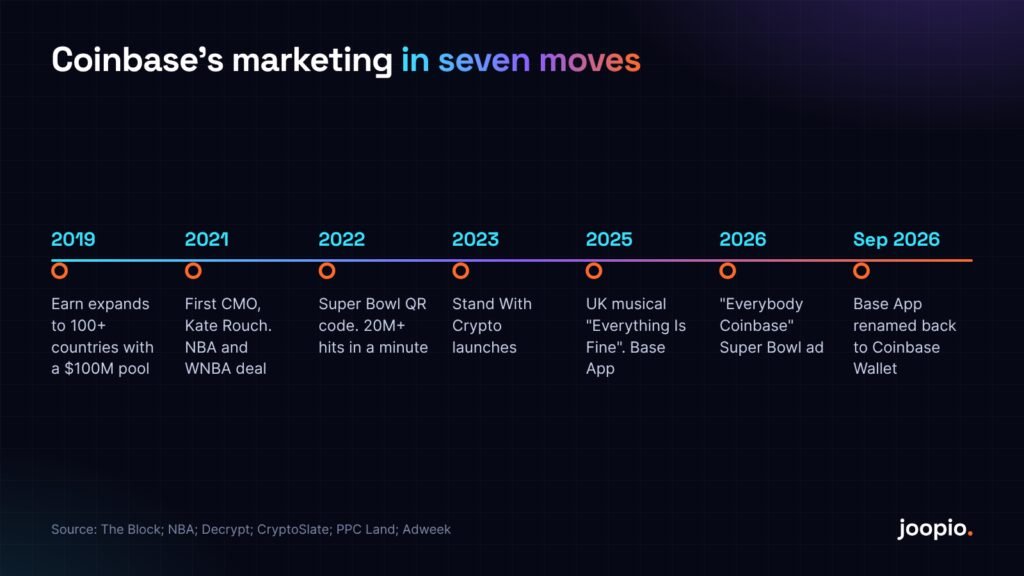
As marketing, it does three things. It gives users a reason to come back that has nothing to do with prices. It builds a contactable list of the most committed customers. And it makes Coinbase the voice of the industry in Washington. It has limits: CryptoSlate pointed out that the four million members did not get the CLARITY Act through the Senate, and the group has not said how many are verified US voters.
The lesson: if your customers share a cause, give them a way to act on it. A movement keeps people engaged through the quiet months, when a product alone will not.
6. It admits when a rebrand doesn’t work
In July 2025 Coinbase renamed Coinbase Wallet as the Base App, pitched as an “everything app” with social networking, messaging and payments. By March 2026 Brian Armstrong said the social experiment “didn’t quite work”. In September 2026 the app went back to the Coinbase Wallet name, now pitched as a trading front door with perpetual futures, prediction markets and tokenised stocks. Coinbase declined to say whether the change has grown its users.
The lesson: a new name will not create demand that isn’t there. When the data says a launch has missed, reverse it fast and keep the parts that worked.
What Coinbase’s numbers say about 2026
The machine is not immune to the market. Monthly transacting users fell from 9.3 million in Q3 2025 to 7.4 million in Q3 2026, and consumer spot trading volume fell 59%. What has grown is the part of the business that pays users to stay: average USDC held in Coinbase products rose 49% to $22 billion. Coinbase is using rewards to hold on to balances while trading is quiet, which is the same “pay for the first step” idea pointed at retention.
What to copy at £5K, £50K and £500K a month
| Budget | What to do |
|---|---|
| £5K | Build template pages for the searches your customer makes before they sign up, such as prices, rates, fees and “how to”. Add a small reward for the first real action, not the download. |
| £50K | All of the above, plus a learn-and-earn style onboarding flow, one owned stunt a quarter with a clear action on screen, and a list of your most engaged users you can mobilise. |
| £500K | A national media moment built around a QR code or code word, a sports or culture partner you keep through the downturn, and rewards that hold balances, all inside your financial promotion rules. |
Questions founders ask
What is Coinbase’s marketing strategy in one line?
Own the simple, regulated corner of crypto, win the searches that come before a sign-up, and pay people to take their first step.
Did the Super Bowl QR code ad work?
For traffic, yes: more than 20 million people tried to reach Coinbase in a minute and Marketing Brew reported a 24% sign-up rate on 11.7 million visits. It also crashed access for many people, which is the lesson in load-testing.
Can a UK fintech copy Coinbase’s rewards?
Partly. UK crypto promotions have strict rules on incentives and risk warnings, which is why Coinbase’s UK TV musical was turned down by Clearcast and ran online instead. Check the rules before you launch any reward. This is a marketing overview, not legal advice.
What not to copy
- A big media moment your servers cannot handle.
- A rebrand that asks users to want something they have not asked for.
- Rewards with no link to a real first action, which buy sign-ups that never trade.
Coinbase’s best marketing does not look like marketing. It looks like a price page, a lesson and a cause. If you’re marketing a crypto or fintech product and want this thinking applied to yours, see our crypto marketing agency work.
Sources: Decrypt, Coinbase QR code Super Bowl ad yields over 20M hits in a minute; Marketing Brew, Coinbase’s advertising and brand strategy; sec-api.io, Coinbase Q3 2026 earnings analysis; GuerrillaBuzz, Coinbase SEO analysis; The Block, Coinbase Earn expands to over 100 countries; Coinbase rewards page; NBA, Coinbase partnership announcement; CryptoSlate, Stand With Crypto launch; CoinDesk, Stand With Crypto passes one million; CryptoSlate, Stand With Crypto’s four million advocates; PPC Land, Coinbase musical ad rejected for UK broadcast; Adweek, Coinbase’s 2026 Super Bowl ad; The Block, Base App renamed back to Coinbase Wallet; Brand Innovators, Kate Rouch at the Marketing Leadership Summit (YouTube). Positioning and channel charts are Joopio’s analysis of public activity.
Samit Patel

Hi, I’m Samit Patel PRODUCT LAUNCH, KICKSTARTER AND INDIEGOGO RECOMMENDED EXPERT THAT GIVES BACK.


